Trump’s ‘Stone Age’ Doctrine: Investigative Report on Iran-Israel Conflict & Hormuz Crisis | KhabarForYou
- Khabar Editor
- 02 Apr, 2026
- 97543

Email:-infokhabarforyou@gmail.com
Instagram:-@khabar_for_you


In a 19-minute prime-time address delivered from the Cross Hall of the White House on Wednesday, U.S. President Donald Trump declared the month-long war against Iran a "brilliant success" that is "nearing completion." However, beneath the triumphalist rhetoric of "swift, decisive victory" lies a region in unprecedented flames, a global energy market on the brink of cardiac arrest, and a diplomatic vacuum that has left even Washington’s traditional allies gasping for air.
Read More - Mumbai Horror: Auto Driver Smashes 4-Year-Old’s Head | Investigative Report | Khabar For You
The ‘Stone Age’ Ultimatum
The President’s latest doctrine is as blunt as it is perilous. While claiming that Iran’s "New Regime President" (referring to Masoud Pezeshkian) has reached out for a ceasefire, Mr. Trump has tethered any cessation of hostilities to a singular, near-impossible condition: the total and "unfettered" reopening of the Strait of Hormuz.
"Until then," the President wrote in a characteristic social media salvo, "we are blasting Iran into oblivion or, as they say, back to the Stone Ages!"
The investigative analysis by KhabarForYou suggests this is more than just rhetoric. Satellite imagery and Pentagon leaks indicate that since the initial strikes on February 28 - which resulted in the assassination of Supreme Leader Ayatollah Ali Khamenei - the U.S. has transitioned from "decapitation strikes" to a systematic dismantling of Iran’s civilian and dual-use infrastructure.
A Chokehold on Global Energy
The Strait of Hormuz, a 21-mile-wide artery through which 20% of the world’s oil flows, remains the war’s most volatile flashpoint. In a move that sent Asian markets - including the Nikkei and Hang Seng - into a tailspin, Mr. Trump suggested that the U.S. no longer "needs" the Strait and urged oil-dependent nations to "grab it and cherish it" themselves.
For India, this "outsourcing" of maritime security is a nightmare scenario. New Delhi, which has already seen six of its citizens killed in the crossfire, now faces crude prices hovering at $114 a barrel. "The U.S. is essentially telling the world that it will break the door down but won't stay to fix the lock," a senior Indian diplomat told our reporters on condition of anonymity.
The Battlefield Reality: A ‘Disaster’ in the Making?
While Mr. Trump claims the Iranian Navy and Air Force have been "decimated," the ground reality offers a more complex, grimmer picture:
Asymmetric Retaliation: Despite the "decimation" of their formal navy, Iranian-aligned militias and IRGC remnants continue to strike U.S. bases in the Persian Gulf and Israel. Last week’s strike on the Prince Sultan Air Base in Saudi Arabia, which damaged a U.S. AWACS aircraft, underscores the limits of air superiority.
The Nuclear Shadow: The assassination of Ayatollah Khamenei has had a catastrophic unintended consequence: the voiding of his fatwa against nuclear weapons. Reports from Tehran suggest the Iranian Parliament is now actively debating a formal withdrawal from the Nuclear Non-Proliferation Treaty (NPT).
The Humanitarian Cost: Sources in Tehran report over 1,300 deaths, including a tragic strike that reportedly claimed the lives of 160 schoolchildren in the early days of the conflict.
The NATO Rift and the "Paper Tiger"
In a stunning departure from decades of transatlantic policy, Mr. Trump has used the Iran conflict to settle old scores with NATO. Describing the 77-year-old alliance as a "paper tiger," he threatened to withdraw U.S. membership if European allies do not contribute "boots and billions" to the West Asia theatre. This has triggered a constitutional crisis in several European capitals, with leaders in Berlin and Paris accusing Washington of launching an "illegal, unprovoked war of choice."
Internal Friction: The "Israel’s War" Narrative
Domestically, the "47th President" is facing a rebellion from his own base. While figures like Senator Ted Cruz have lauded the "overwhelming victories," others - including Marjorie Taylor Greene - have criticized the lack of an exit strategy and the soaring cost of living. The resignation of Joe Kent from the National Counterterrorism Center, citing "pressure from Israel and its powerful American lobby," has provided fuel to the fire of domestic dissent.
The Indian Dilemma
Prime Minister Narendra Modi’s recent conversation with Mr. Trump - the first since the war began - highlights India's precarious position. New Delhi is walking a tightrope: protecting the millions of Indians living in the Gulf, securing energy interests, and resisting U.S. attempts to bring the "theatre of war" into the Indian Ocean, as seen with the recent torpedoing of the IRIRIS Dena off the coast of Sri Lanka.
Conclusion: No Easy Off-Ramp
As the war enters its second month, the "two-to-three week" timeline for a U.S. exit looks increasingly optimistic. With the Strait of Hormuz effectively closed to "hostile" vessels and Iran demanding war reparations as a prerequisite for peace, the "Stone Age" doctrine may have achieved destruction, but it has yet to achieve security.
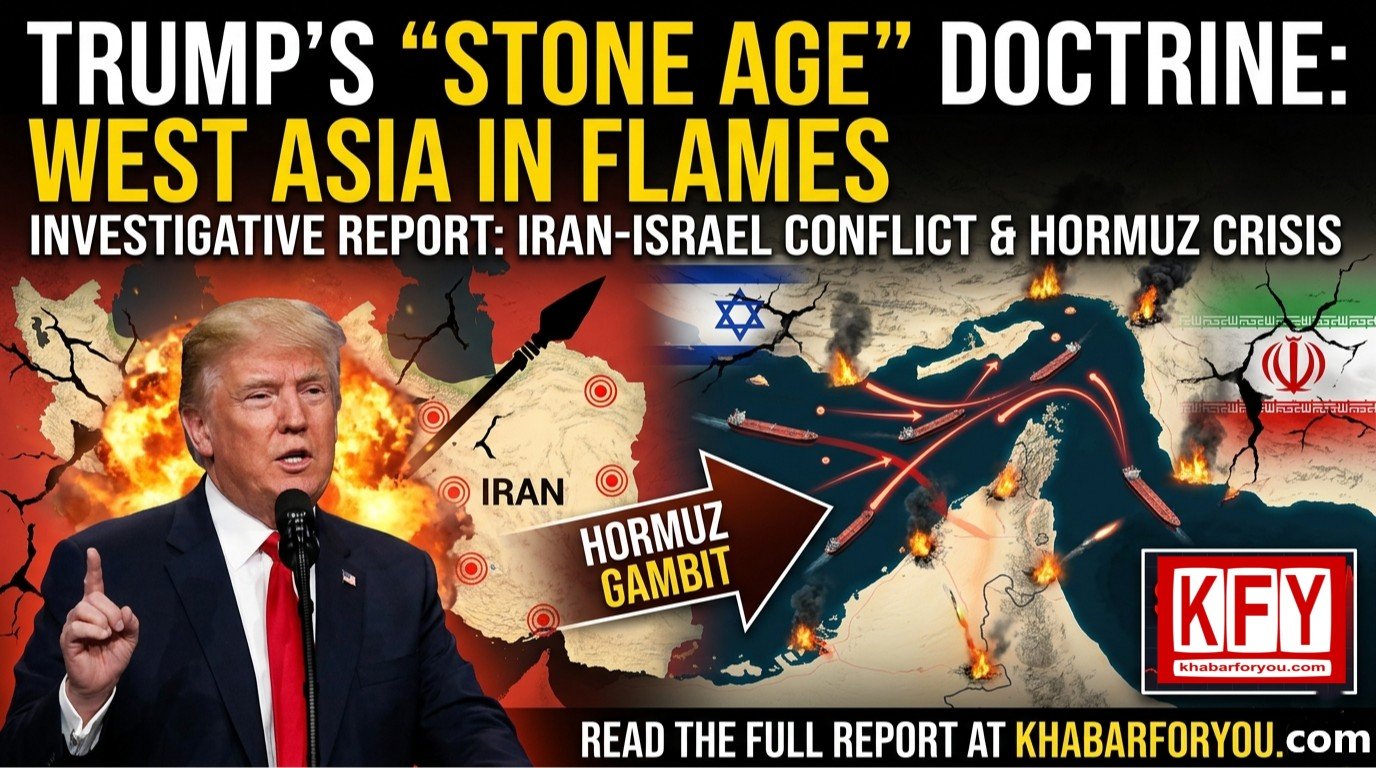
The world now watches the "Hormuz Gambit" with bated breath. If the U.S. chooses further escalation - specifically a ground invasion - the global economy may not just slow down; it may stop entirely.
Business, Sports, Lifestyle ,Politics ,Entertainment ,Technology ,National ,World ,Travel ,Editorial and Article में सबसे बड़ी समाचार कहानियों के शीर्ष पर बने रहने के लिए, हमारे subscriber-to-our-newsletter khabarforyou.com पर बॉटम लाइन पर साइन अप करें। |
| यदि आपके या आपके किसी जानने वाले के पास प्रकाशित करने के लिए कोई समाचार है, तो इस हेल्पलाइन पर कॉल करें या व्हाट्सअप करें: 8502024040 |
#KFY #KFYNEWS #KHABARFORYOU #WORLDNEWS
नवीनतम PODCAST सुनें, केवल The FM Yours पर
Click for more trending Khabar
Leave a Reply
Your email address will not be published. Required fields are marked *
Search
Category